





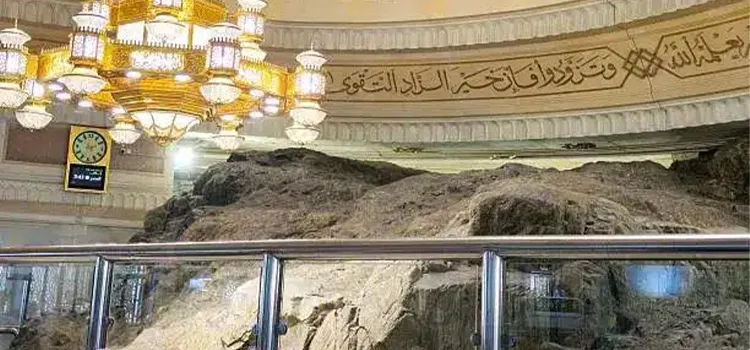
Walking between Safa and Marwa seven times is essential to complete Umrah. Being a prominent Umrah ritual, every pilgrim becomes curious about the significance of these two hills and walking between them. Safa and Marwa are sacred landmarks, with a prominent position in Islamic history. But in addition to its history, these hills are also quite significant for supplications and making duas during the pilgrimage. If you are going for an Umrah soon and want a complete guide to the Safa and Marwa dua on what to recite before, during, and after Sa'i in Umrah, you have come to the right place. While preparing for your pilgrimage, many travellers find that arranging accommodations, transport, and other essentials in advance helps them focus fully on worship and the spiritual aspects of Umrah, including the Sa'i between Safa and Marwa. Choosing the right Umrah packages can make these preparations easier and more organised.
Sa'i is an obligatory pilgrimage ritual. To complete this ritual, you must walk seven times between Safa and Marwa. One lap from Safa to Marwa counts as one lap, while the second lap is from Marwa to Safa. In this way, you must complete seven laps. Sa'i must be performed by every pilgrim after Tawaf.
Some people have the misconception that there are some mandatory supplications to recite during this ritual. But this is not true. You are free to recite whichever supplications and duas that you want to recite. However, there are some Sunnah supplications that our beloved Prophet Muhammad (SAW) recited while performing Sa'i. We will list those supplications along with other suggested, highly-rewarding supplications and duas that you can recite during your time at the sacred Safa and Marwa.
Quranic Reference for Safa and Marwa
Arabic:
إِنَّ الصَّفَا وَالْمَرْوَةَ مِن شَعَائِرِ اللَّهِ
Transliteration:
Innaṣ-ṣafā wal-marwata min shaʿāʾirillāh
Translation:
"Indeed, Safa and Marwa are among the symbols of Allah."
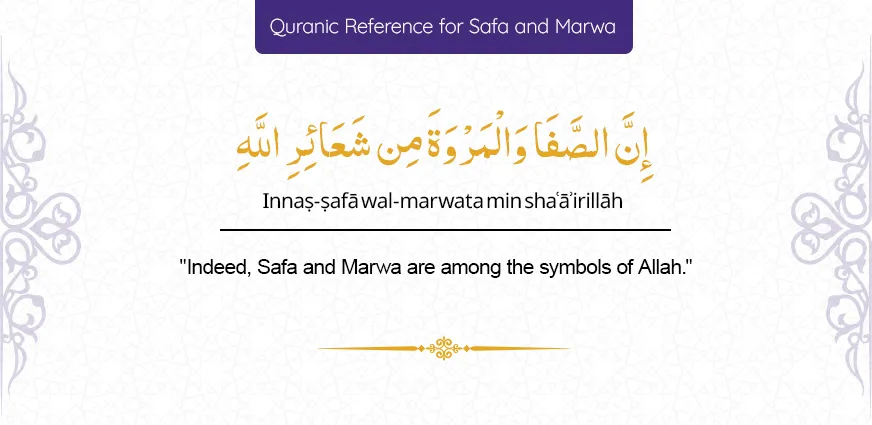
Through this verse, we understand that these sacred hills are far more than mere landmarks. They are divine symbols that strengthen your connection with the Almighty. It is also an act of worship and devotion.
Preparing Before Taking Round Between Safa and Marwa & Dua to Recite
Before you arrive at Safa and Marwa for Sa'i, you must prepare yourself. You must make your Niyyah and perform wudu before you arrive at the two sacred hills. As you stand at Safa, face the Holy Kaaba and recite the following supplication.
Arabic:
إِنَّ الصَّفَا وَالْمَرْوَةَ مِن شَعَائِرِ اللَّهِ
This is the same verse as above and is the perfect way to start your round. Glorify the Almighty and raise your hands in prayer.
Sunnah Dua to Recite at Safa and Marwa
Here is a Sunnah dua that is highly significant to recite as you stand at Safa and Marwa for Sa'i. This supplication is highly rewarding and surely suits the spiritual essence of this pilgrimage ritual.
Arabic:
اللَّهُ أَكْبَرُ، اللَّهُ أَكْبَرُ، اللَّهُ أَكْبَرُ
لَا إِلٰهَ إِلَّا اللَّهُ وَحْدَهُ لَا شَرِيكَ لَهُ،
لَهُ الْمُلْكُ وَلَهُ الْحَمْدُ، وَهُوَ عَلَىٰ كُلِّ شَيْءٍ قَدِيرٌ
لَا إِلٰهَ إِلَّا اللَّهُ وَحْدَهُ،
أَنْجَزَ وَعْدَهُ، وَنَصَرَ عَبْدَهُ، وَهَزَمَ الْأَحْزَابَ وَحْدَهُ
Transliteration:
Allāhu akbar, Allāhu akbar, Allāhu akbar.
Lā ilāha illallāhu waḥdahu lā sharīka lah,
lahul-mulku wa lahul-ḥamd, wa huwa ‘alā kulli shay’in qadīr.
Lā ilāha illallāhu waḥdah,
anjaza wa‘dah, wa naṣara ‘abdah, wa hazamal-aḥzāba waḥdah.
Translation:
"Allah is the Greatest, Allah is the Greatest, Allah is the Greatest.
There is no god but Allah alone, with no partner.
To Him belongs sovereignty and praise, and He has power over all things.
There is no god but Allah alone.
He fulfilled His promise, helped His servant, and defeated the allies by Himself."
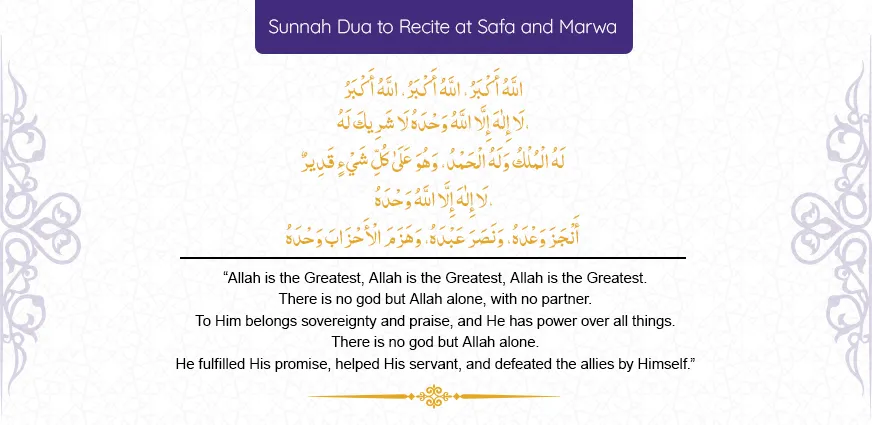
After reciting this supplication, you can also make any personal dua that you want. Don't forget to ask for forgiveness and the mercy of the Almighty. Also, ask for his guidance and acceptance of Umrah. This is also the time when you can recite any personal and specific supplications and make duas for yourself, your family, and friends.
What to Recite Between Safa and Marwa?
As they are not specified duas to recite between Safa and Marwa, you can recite whichever duas your heart desires. The time that you spend between Safa and Marwa is highly valuable for making personal supplications. You can recite the following duas at Safa and Marwa.
- Any du'a from the Qur'an or Sunnah
- Dhikr such as SubhanAllah, Alhamdulillah, Allahu Akbar
- Salawat upon the Prophet (SAW)
- Du'as for forgiveness, health, provision, guidance, and Jannah
Commonly Recite Dua During Between Safa and Marwa
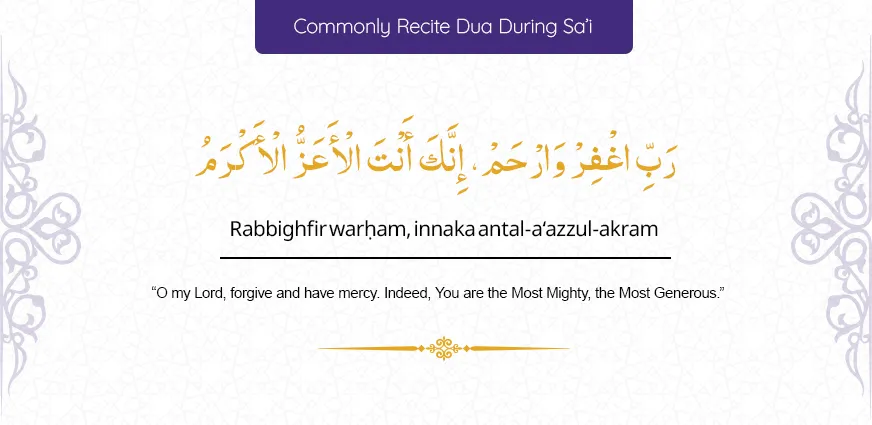
No doubt every pilgrim has the freedom to recite the duas and supplications of their choice. But there are some commonly recited duas that many pilgrims recite while performing Sa'i during Umrah. One of these commonly recited supplications is the Sunnah supplication mentioned above. Here is another one that you can recite.
Arabic:
رَبِّ اغْفِرْ وَارْحَمْ، إِنَّكَ أَنْتَ الْأَعَزُّ الْأَكْرَمُ
Transliteration:
Rabbighfir warḥam, innaka antal-a‘azzul-akram
Translation:
"O my Lord, forgive and have mercy. Indeed, You are the Most Mighty, the Most Generous."
Other Duas to Recite During Safa and Marwa
Here are some other duas that you can add to your dua list to recite during Sa'i.
Dua for Forgiveness
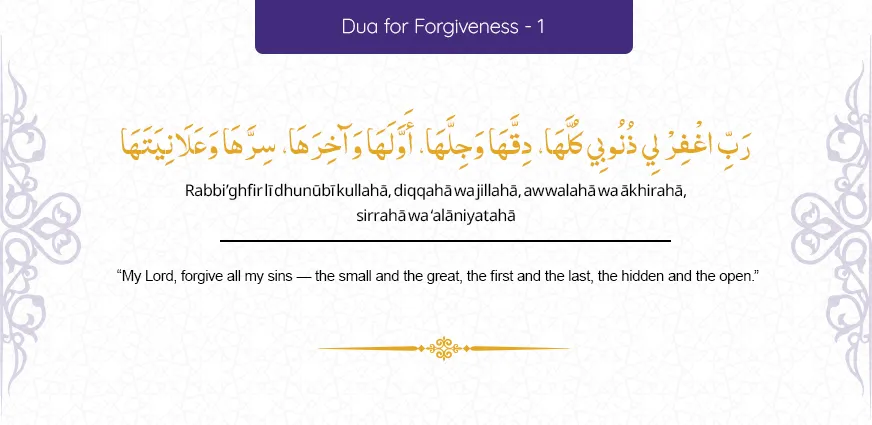
Asking for forgiveness of the Almighty is one of the main purposes of the Umrah. Safa and Marwa are spiritually significant landmarks, and the supplications made here are believed to be readily accepted. So, take this golden opportunity to ask the Almighty for the complete forgiveness of your sins. Here is a dua for forgiveness that you can recite during this time.
Arabic:
رَبِّ اغْفِرْ لِي ذُنُوبِي كُلَّهَا، دِقَّهَا وَجِلَّهَا، أَوَّلَهَا وَآخِرَهَا، سِرَّهَا وَعَلَانِيَتَهَا
Transliteration:
Rabbi'ghfir lī dhunūbī kullahā, diqqahā wa jillahā, awwalahā wa ākhirahā, sirrahā wa 'alāniyatahā
Translation:
"My Lord, forgive all my sins — the small and the great, the first and the last, the hidden and the open."
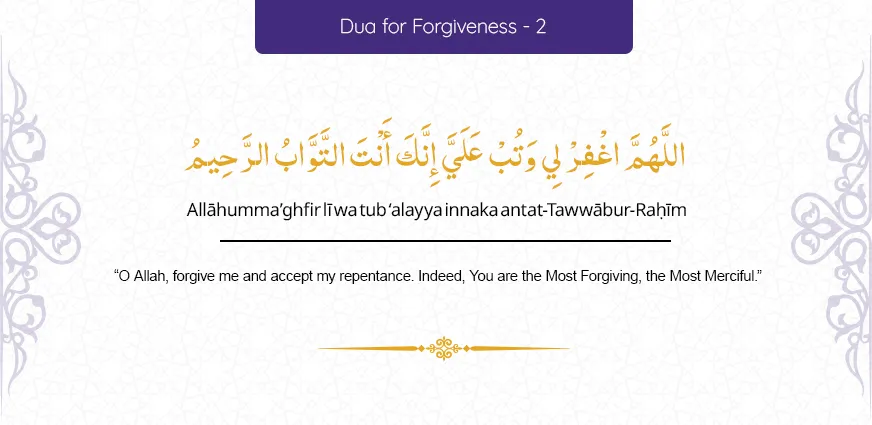
Another short but powerful dua for forgiveness is as follows.
Arabic:
اللَّهُمَّ اغْفِرْ لِي وَتُبْ عَلَيَّ إِنَّكَ أَنْتَ التَّوَّابُ الرَّحِيمُ
Transliteration:
Allāhumma'ghfir lī wa tub 'alayya innaka antat-Tawwābur-Raḥīm
Translation:
"O Allah, forgive me and accept my repentance. Indeed, You are the Most Forgiving, the Most Merciful."
Dua for Mercy
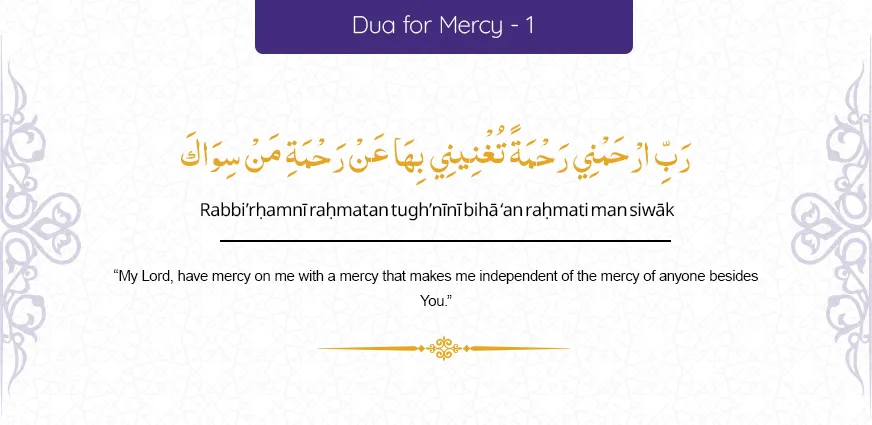
We are nothing without Allah Almighty's mercy. Therefore, make sure to ask for His limitless mercy during Sa'i.
Arabic:
رَبِّ ارْحَمْنِي رَحْمَةً تُغْنِينِي بِهَا عَنْ رَحْمَةِ مَنْ سِوَاكَ
Transliteration:
Rabbi’rḥamnī raḥmatan tugh’nīnī bihā ‘an raḥmati man siwāk
Translation:
"My Lord, have mercy on me with a mercy that makes me independent of the mercy of anyone besides You."
Another highly recommended dua for both mercy and forgiveness is as follows.
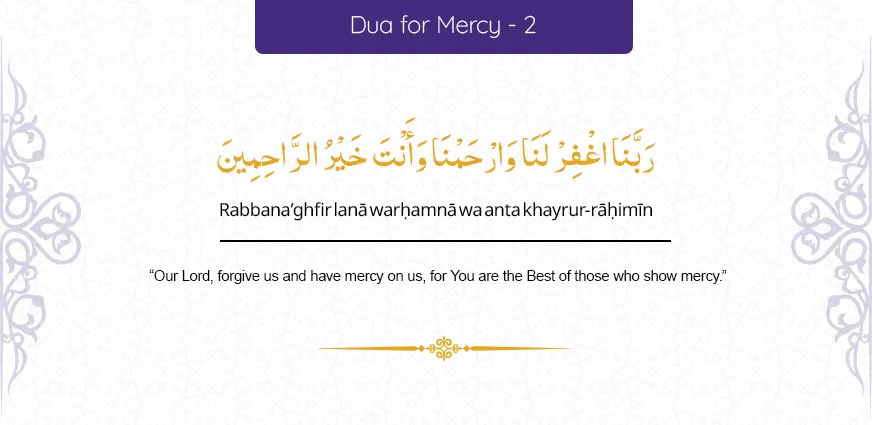
Arabic:
رَبَّنَا اغْفِرْ لَنَا وَارْحَمْنَا وَأَنْتَ خَيْرُ الرَّاحِمِينَ
Transliteration:
Rabbana’ghfir lanā warḥamnā wa anta khayrur-rāḥimīn
Translation:
"Our Lord, forgive us and have mercy on us, for You are the Best of those who show mercy."
Dua for Ease and Acceptance
As you immerse yourself in pilgrimage and endless worship during Umrah, make sure to ask Allah Almighty for ease and acceptance.
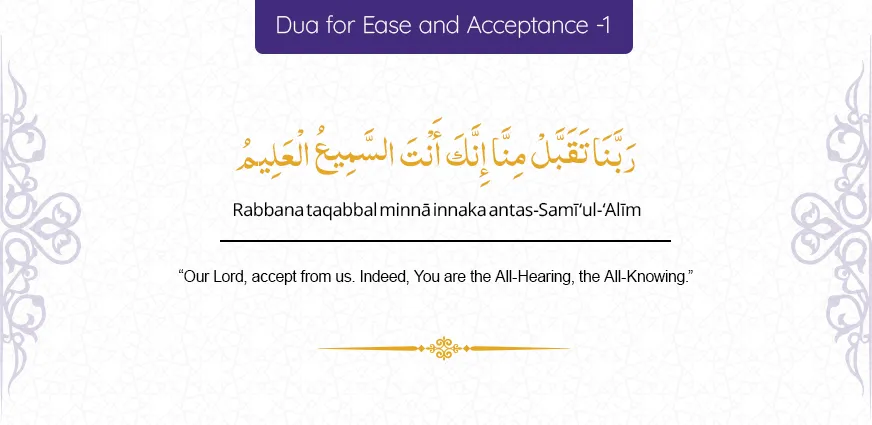
Arabic:
رَبَّنَا تَقَبَّلْ مِنَّا إِنَّكَ أَنْتَ السَّمِيعُ الْعَلِيمُ
Transliteration:
Rabbana taqabbal minnā innaka antas-Samī‘ul-‘Alīm
Translation:
"Our Lord, accept from us. Indeed, You are the All-Hearing, the All-Knowing."
Here is another Umrah-specific dua for acceptance.
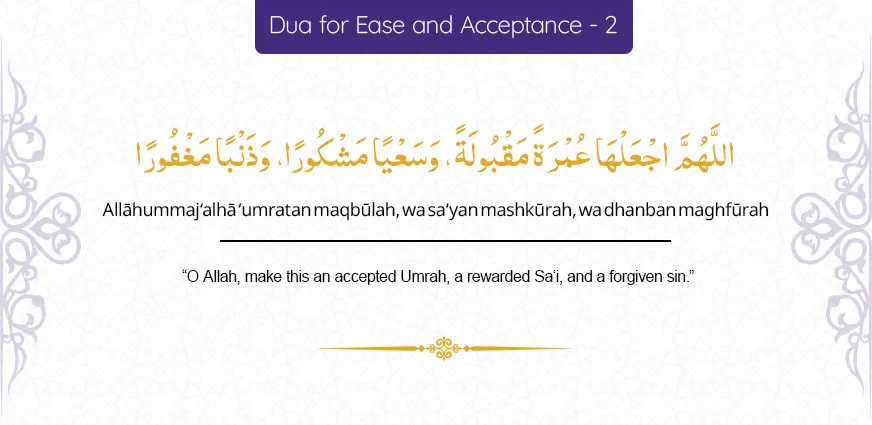
Arabic:
اللَّهُمَّ اجْعَلْهَا عُمْرَةً مَقْبُولَةً، وَسَعْيًا مَشْكُورًا، وَذَنْبًا مَغْفُورًا
Transliteration:
Allāhummaj‘alhā ‘umratan maqbūlah, wa sa‘yan mashkūrah, wa dhanban maghfūrah
Translation:
"O Allah, make this an accepted Umrah, a rewarded Sa'i, and a forgiven sin."
Duas to Recite After Completing Seven Round Between Safa and Marwa
After completing seven round between safa and marwa, ask Allah Almighty whatever your heart desires in this world with a sincere intention. Make all the personal duas at this time. Don't forget the duas that your loved ones have told you to make on their behalf during this spiritual retreat. You can also end your seven round with a short dhikr of Subhanallah, Alhamdulillah, and Allahu Akbar.
You can recite supplications and make duas of your choice. Just keep in mind that the sincerity of Niyyah, consistency, and a firm faith are much more important than reciting long verses and supplications. So, let your duas be sincere and meaningful.
Guidelines for Reciting Duas at Safa Marwa
Here are some tips and guidelines for reciting duas at Safa and Marwa.
- You can say a dua aloud or silently; however, reciting silently is preferred so as not to that you don't disturb other pilgrims.
- You are free to make duas in whichever language, whether it is Arabic, transliteration, or your own language.
- Focus on the spiritual connection rather than the words.
- Walk calmly and with patience. Navigate the crowds with patience and don't push other pilgrims to complete your rituals quickly.
- Repeat any dua as many times as you like, or switch between recommended and personal duas.
Reflection on Hazrat Hajar's Story
As you might already know, seven rounds between Safa and Marwa are performed to commemorate the hardships and struggles of Hazrat Hajar. Prophet Ibrahim (AS) left his wife, Hazrat Hajar and their infant son, Hazrat Ismail (AS), in a desert on the command of Allah Almighty. Hazrat Hajar ran between the two hills of Safa and Marwa in search of water for her infant. As a result of her firm faith, Allah Almighty granted her wish through the miraculous emergence of the Zamzam well.
Every step Hazrat Hajar took symbolised faith, patience, and reliance on Allah Almighty. Performing this ritual will remind you to trust the Creator of this universe in all matters of life. It refreshes your faith and teaches the ultimate lesson of perseverance.
Summing Up
Safa and Marwa's symbolic and spiritual importance is unmatched. No matter which duas and supplications you recite as you perform Sa'i, keep a sincere heart and intentions and know that all your heart's wishes will be fulfilled. The only thing that you can do is take this time to recite as many supplications as possible and perform dhikr to get closer to Allah Almighty.
No Muslim would miss out on the chance to ask for the forgiveness, mercy, and guidance of the Almighty. And you get a great chance of it while performing seven round between Safa and Marwa. And let's not forget your personal duas, whose acceptance increases tenfold while performing Sa'i.