






When you plan an Umrah, you are planning to meet your Lord, and there are some protocols you need to follow. One of them is entering the state of Ihram. Ihram is not merely a kind of clothing. It is a sacred frame of mind and heart. It begins when you enter the state of Ihram and make the intention for Umrah, followed by reciting the Talbiyah.
Choosing well-organized Umrah packages can help women travel with comfort, proper guidance, and peace of mind, especially when learning the rules of Ihram. For many women, the first Umrah is a feeling that cannot be described in words. At the same time, it can also feel overwhelming. You might have multiple questions popping into your head, such as: What should I wear? Do I have to wear white like men? Can I use deodorants or perfumes? What if I get my period while travelling? Do I need to uncover my face? Can I change my clothes? Can I cut my nails or hair? And so on, right?
Ihram reminds the believer to leave behind their usual routine and enter a state of humility, patience, and self-control. It is a lesson in discipline, reduces distractions, and keeps the heart connected to Allah during Umrah. So if you are looking for simple Ihram rules for ladies in clear terms, you'll find:
- How Ihram works for women
- What is permissible and what is not.
- The approach to common issues of Hanafi rulings.
- How to behave in cases such as delays in travelling, menstruation or errors.
- Some tips to follow to avoid stressing and be within the rules.
It is designed to empower women to complete Umrah without fear, misunderstanding, or unnecessary anxiety. Understanding the Ihram rules for women makes it much easier to follow and more meaningful.
What Is Ihram for Ladies?
Ihram for women means entering a state of worship with specific intentions and limits.
For women, Ihram is about:
- Intention
- Modesty
- Avoiding certain actions until Umrah is complete
If you had in your mind that you also need to wear something white, just like men do. It's not like that. It's pretty simple for ladies. For women, your Ihram garments are your regular Abaya/Hijab, which should be free-flowing. You cannot cover your face, hands or feet. You can wear any colour you want, but not anything too bright that draws attention. Your heart and your intention are what matter most. When a woman starts Ihram, she makes a promise to stay focused on worship. This means she stops doing certain things until she finishes her Umrah.
When Does a Woman Enter Ihram for Umrah?
A woman enters Ihram at the Miqat or before crossing it, depending on her journey.
Before entering the Ihram, she should try to:
- Perform ghusl, even if she is menstruating.
- Wear modest clothing that covers properly.
- Pray two rak'ahs if she is not menstruating.
- Make an intention for Umrah
- Recite the Talbiyah
Hanafi scholars say your intention is what matters most. If you don't mean it in your heart, you are not in Ihram. The intention is the "start button" for your worship.
Ihram Clothing Rules for Ladies

Many women have this question: What should they wear for Ihram? No doubt it's a valid question. It's easy! Women can wear any modest clothes. Make sure they are loose and plain. You should avoid wearing anything that draws attention. The goal is to stay covered, comfortable, and focused on worship.
Is There a Specific Ihram Dress for Women?

There is no fixed Ihram garment for ladies. What matters most is that the clothing follows Islamic modesty.
Women can wear:
- Normal stitched clothing
- abaya, jilbab, or any loose dress
- any modest colour such as black, white, beige, or similar
Conditions to keep in mind:
- The body should be covered except for the face and hands.
- The fabric should not be tight or transparent.
- Clothing should not resemble men's clothing in style.
- Avoid clothing designed to stand out or attract attention.
According to Hanafi fiqh, stitched clothing is fully allowed for women in Ihram, because Ihram for women is not about the type of garment, but about intention and modesty. It is also fine to change clothes if they get dirty or uncomfortable, as long as the new clothes follow the same modest rules.
Can Women Cover Their Heads in Ihram?
Yes! Covering the head remains required. Women should avoid decoratively styling the hijab. The purpose is to cover, not to beautify. Women should be as simple as they can. They should avoid wearing any jewellery or makeup. They are also not allowed to cover their face, hands, and feet.
- A hijab or scarf should be worn.
- Hair should stay covered properly.
- Covering the head does not break or harm the Ihram.
This is one of the key differences between men and women.
Can Women Cover Their Faces in Ihram?
Face coverings are among the most common areas of confusion. Many women worry about modesty while also trying to follow the rules correctly. The key is understanding what counts as "covering" and what is simply using a loose barrier for privacy.
Hanafi ruling on face covering
According to Hanafi scholars:
- A woman should not cover her face directly while in Ihram.
- If non-mahram men are present, modesty and hijab should still be observed.
This means the face itself should not be wrapped or pressed against cloth.
Practical solution:
- Use a loose veil that hangs in front of the face without touching it.
- Or lower a cloth from the head so it drapes in front when needed, especially in crowded areas.
If the cloth accidentally touches the face briefly, it is not a big problem. Still, it should not be deliberately pressed against the skin.
This approach allows women to stay modest while still respecting the limits of Ihram.
Footwear Rules for Ladies in Ihram
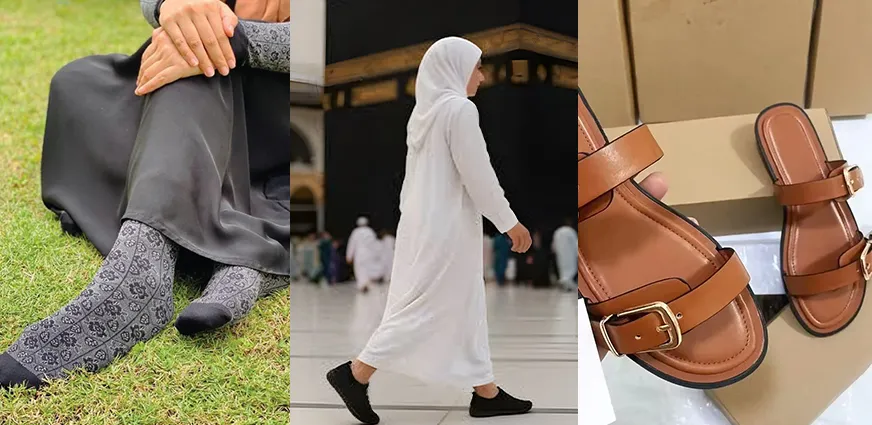
Women can wear whatever footwear is comfortable, as long as it is modest and practical.
Women may wear:
- shoes
- sandals
- socks
Unlike men, women do not have rules about the top of the foot being uncovered.
Choose footwear that:
- Supports walking long distances
- without causing injury or pain
- It is simple and unscented, with no perfumed polish.
Comfort is essential, especially during Tawaf and Sa'i.
Perfume and Fragrance Rules for Ladies

Fragrance is one of the key things to avoid after entering Ihram.
After making intention and entering Ihram, women should not use:
- perfume
- scented lotions or creams
- fragranced soap, shampoo, or wipes
Before Ihram:
- Perfume may be applied.
- If a faint scent persists later, it is forgiven unless intentionally reapplied.
Many toiletries today contain fragrance, so it helps to pack items labelled "unscented" or "fragrance-free." The goal is to avoid using smell as adornment while in this sacred state.
Can Women Cut Hair or Nails in Ihram?
While in Ihram, women should avoid:
- Cutting or trimming hair
- trimming nails
- removing body hair intentionally
These acts are signs of grooming and self-beautification, which contradict the state of Ihram. If hair falls naturally while combing or washing, that is fine. There is no sin in accidental hair fall. Hair and nail trimming should only be done after completing Umrah, when exiting Ihram.
Ihram Rules for Ladies During Menstruation
Menstruation is one of the most asked-about topics because many women worry their Umrah will be affected. The key is to know what can still be done and what should be delayed until purity returns.
Can a Woman Enter Ihram While Menstruating?
Yes. A woman can still enter the Ihram even if she is on her period.
She may:
- make intention
- Recite the Talbiyah
- Stay in the state of Ihram.
- Travel and prepare with everyone else.
But:
- She should not perform Tawaf until she becomes clean.
According to Hanafi fiqh, Tawaf requires purification, just like prayer. There is no need to delay the Ihram itself. She waits until she can complete Tawaf.
If her period continues longer than expected, she remains patient and stays in the Ihram until she becomes clean.
Can Women Pray Salah in Ihram?
Ihram does not change the normal rules of prayer. The same conditions apply.
- Women who are not menstruating can pray as usual.
- Women who are menstruating do not pray until they are clean.
They can still make dua, remember Allah, and recite Talbiyah, but they should not perform the formal prayer during menstruation.
Talking, Sleeping, and Daily Activities in Ihram
Ihram is a spiritual state, not a restriction on normal life. Daily activities are allowed as long as they are respectful.
While in Ihram, women may:
- Talk usually and interact with others.
- Eat and drink
- Sleep and rest
- Bathe using unscented products.
- Use mobile phones
- Change clothes when needed.
The purpose is to remain calm, avoid arguments, and maintain good manners. Ihram trains patience, not hardship.
Marital Relations and Intimacy
This is an important rule because it protects the sacred focus of Umrah.
In Ihram, it is strictly prohibited to engage in:
- sexual relations
- physical intimacy
- Words or behaviour that lead to desire
Breaking this rule can invalidate parts of Umrah and may require a penalty (dam). Couples should treat Ihram with care and maintain a respectful distance until the rituals are finished.
Common Mistakes Women Make in Ihram
Many mistakes happen because of assumptions, cultural habits, or misinformation. Knowing them in advance helps avoid stress and penalties.
Some frequent mistakes include:
- Thinking the black abaya is compulsory
- Believing stitched clothes are not allowed.
- Using scented sanitiser, wipes, or soap without checking
- Covering the face directly with a niqab so it touches the skin
- Cutting hair or nails without realising they are still in Ihram
- Applying makeup or perfume out of habit
- Assuming they cannot change clothes if they get dirty
Most of these mistakes stem from mixing up men's rules with women's. When unsure, it is always better to ask or check before acting. Learning the rules helps avoid invalid actions and protects the reward of Umrah.
How Does a Woman Exit Ihram?
Leaving Ihram is simple once the main rituals are completed.
After completing:
- Tawaf
- Sa'i
She exits the Ihram by cutting a small portion of hair from the ends. About a fingertip length is sufficient, and it should be cut from all sides, not only one strand. It is best to do this in a private place and avoid throwing hair where people walk.
Once the hair is cut:
- Restrictions of the Ihram end
- Normal grooming and fragrance are allowed again.
This marks the completion of Umrah and the return to regular daily rules.
Key Differences Between Men and Women
Some rules are similar for men and women. In this table, you'll find how the rules of Ihram are different for men and women. It helps you see exactly what to wear and what to avoid. For everything else, the general rules of Ihram apply to both.
Rules | Women | Men |
| Specific Ihram Clothing | Not Required | Required (Two plain white sheets) |
| Head covering | Allowed | Not allowed |
| Face covering | Not allowed if touching the face | Not allowed |
| Footwear | Normal shoes permitted | Restrictions apply |
| Cutting hair in the Ihram | Not allowed | Not allowed |
| Perfume | Not allowed | Not allowed |
Final Advice for Ladies performing Umrah
Want to have a peaceful journey of Umrah? You don't have to do much. If you know the rules of Ihram, you need to follow them before starting your sacred journey. Everything will be easy and chaos-free for you. Islam makes things easy: have a good heart, be modest, and follow the way. If you have any questions, ask any scholar you trust. You must have Allah in your heart and mind. Wear loose, simple clothes without any smell. No particular colour is prohibited, but you are not recommended to wear overly bright or decorative clothing; no perfume or scented makeup. You must be patient, as you will encounter crowds in Makkah and Madinah. Worshipping Allah can also be through being good and having good manners. Pray as much as you can. If you lose something minor, there is nothing to worry about. Allah knows you best. It is only the purity of the heart and Taqwa that counts. May Allah accept your Umrah and keep you safe.